Grow Word started with Arthur's love of letters. He's four, and I wanted to make something around his interest in his ABCs. Pattern Garden is the next game in a small learning suite, with its own focus on repeating patterns.
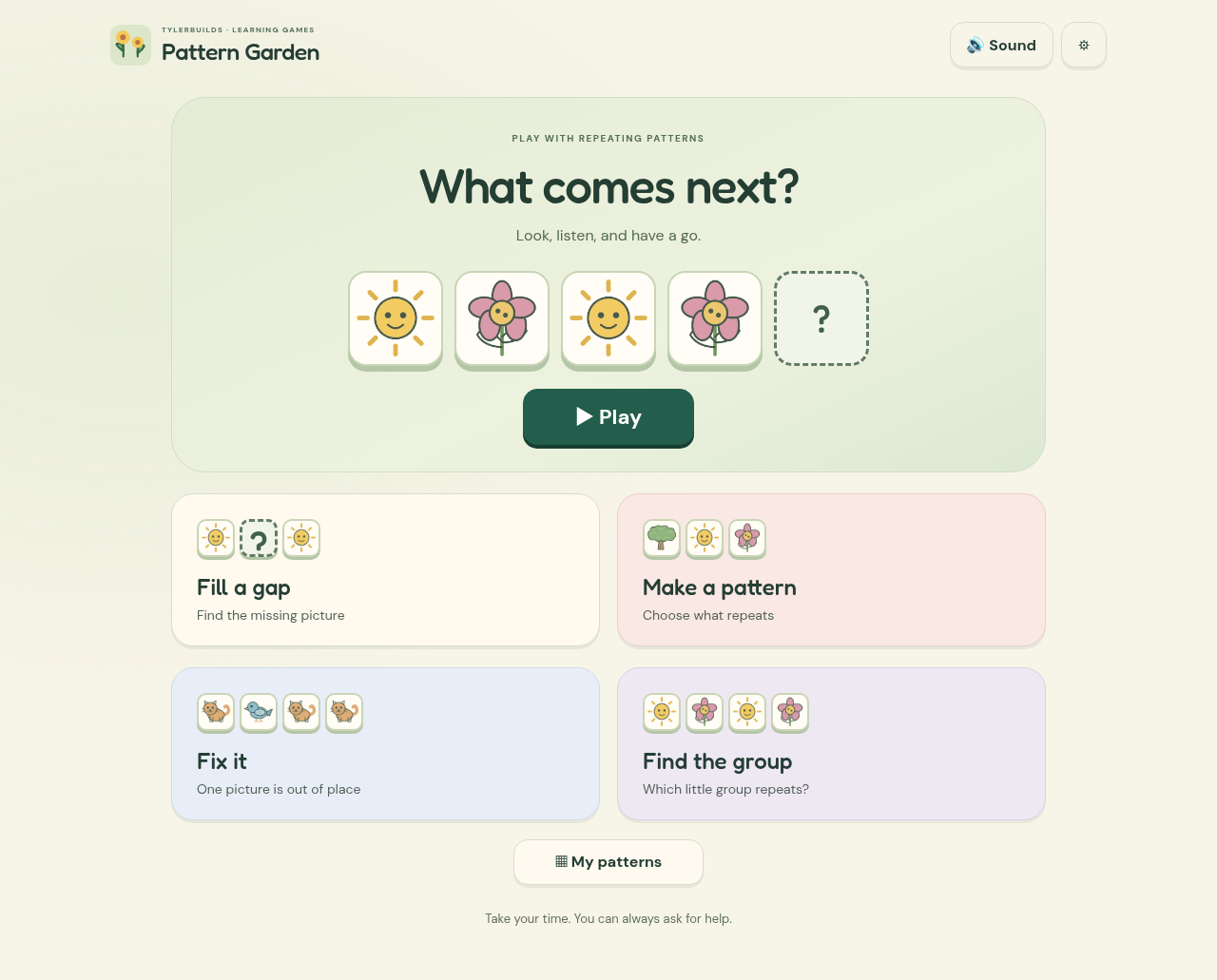
It starts with a simple question: what comes next? You can also find a missing picture, fix a mistake, choose the group that repeats or make a pattern of your own.
Why patterns came next
The review of Grow Word helped me see where to improve its word-building and how it uses help. I also wanted each game to have a clear job. Grow Word can concentrate on letters and words while Pattern Garden explores the little group that repeats.
The wider plan includes separate games for number, shapes, routes and simple investigations. They can share artwork and the practical things that already work, without cramming every subject into one game.
What the first audit caught
The first version had a shortcut I hadn't intended. Every “what comes next?” question stopped after two complete groups. The answer was always the first picture in the row. A child could learn to copy that picture without working out the repeat.
Version two varies where the pattern stops. Questions come from shuffled sets, so the same few examples don't keep coming back. Easy uses alternating pictures. Trickier includes groups such as drum, drum, piano, and patterns with three different pictures.
I also removed the automatic reveal of the repeating group after a correct answer. Show the group is there when you want it. The separate Find the group game asks for the smallest repeat, with choices that can't be answered just by choosing the middle-sized strip.
That work follows the kinds of pattern activities described in NCETM's early-years guidance: continuing partial groups, spotting mistakes, finding the repeating unit and using different materials.
More ways to play with the same idea
Fix it asks you to find the picture that doesn't fit, then replace it. Swap pictures now asks you to build a whole group with new objects. The picture pairs stay visible, so there is help with making that connection.
Make a pattern lets you choose up to four pictures and repeat the group. My patterns keeps your saved creations so you can open and change them later. A pattern made from just one repeated picture is welcome too.
Watch brings a completed pattern to life one picture at a time. It makes one pass and stops; you can stop it sooner. The pictures stay still while solving, and reduced-motion settings keep them still during playback too.
Listen reads the row aloud, including the position of a gap. Try it together gives a spoken suggestion for making the repeat with claps, taps or movements. There are no timers, locked levels or penalties for trying.
What I built it with
Pattern Garden uses HTML, CSS and plain JavaScript, with Codex helping me build and check it. The rules live separately from the pictures, which makes it easier to test the pattern and reuse it with different objects.
Version two uses 24 subjects from Grow Word's existing Moho artwork across eight picture sets. I kept the original exports and matching stills. The spoken instructions are complete British English recordings generated locally with Kokoro's bf_emma voice, played through the audio engine already used by Grow Word.
The game is roughly 5.5 MB. Once its pack has saved successfully, it works offline. A new version waits for the Update game button, and a failed download leaves the earlier saved version available.
Free to play, with saves on your device
There is no account, advertising, purchase, microphone or shared scoreboard. Settings, play counts and up to 100 recent patterns stay in your browser. A grown-up can export or clear them.
The game uses the website's existing static hosting. Playing doesn't make an AI request, database call or paid speech request. Release checks continue to refuse a paid game backend.
Browser data can be cleared or lost, and saves don't automatically move between devices. Save a copy from the grown-up area if you want to keep one.
What still needs observing
The checks cover generated puzzles, retries, help, touch controls, keyboard use, saves, sound, animation and offline updates. They tell me how the software behaves.
I still want to see how children use it. Can they find the repeating group in unfamiliar pictures? Can they make the same pattern with toys later? Play counts alone can't answer that.
The aim is a useful game to play together around ages four to seven, with room to improve as we learn from using it.